In the Greater Sacramento area, sloped lots, seasonal runoff, and expansive clay soils put constant pressure on residential and commercial properties. This page covers the retaining wall services we provide from our Orangevale location. That includes new wall construction, hillside stabilization, drainage integration, and wall repair across Sacramento County communities.
Each section below explains what the service involves, who it helps, and what to expect. If your property has a slope, drainage concern, or failing wall, we can evaluate the site and recommend the right approach.
As an Orangevale landscaping company with decades of local experience, we build and repair retaining walls matched to Sacramento Valley soil conditions, local drainage patterns, and city permit requirements. Our team knows these soils, these slopes, and these neighborhoods.

We evaluate slope, soil, and drainage.

Clear design, materials, timeline, and pricing.

Proper base, drainage, and precision construction.
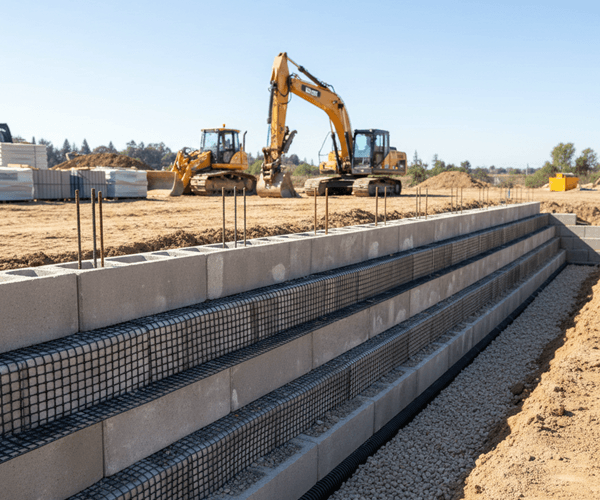
Block and concrete retaining walls are the most requested wall type we build across the Sacramento metro. They work for homeowners leveling sloped yards, creating raised planting beds, or bordering driveways and patios. Commercial property owners use them for parking lots, loading areas, and landscape borders.
Segmental block systems like interlocking masonry units allow curves, corners, and tiered designs without mortar. Poured concrete walls handle heavier loads where structural strength matters most. Both options hold up against Sacramento’s expansive clay soils and seasonal ground movement.
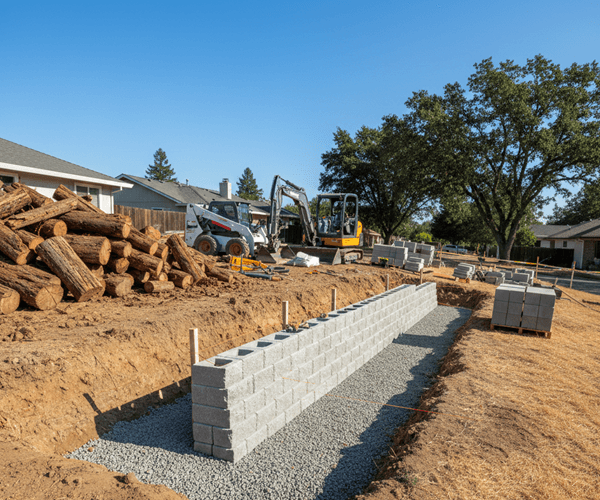
Every wall starts with site grading, a compacted base, and proper backfill behind the structure. These steps prevent settling and shifting over time. You get a wall that stays straight and does its job for years.
Residential block walls are common throughout Fair Oaks, Orangevale, and Citrus Heights neighborhoods where lot grading from the 1970s through 1990s left uneven yard elevations. Commercial concrete walls line business corridors along Greenback Lane and Sunrise Boulevard.
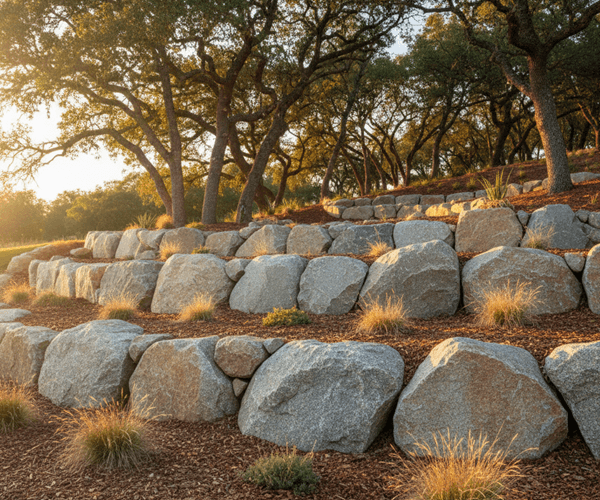
If you want a wall that looks like it belongs on your property, natural stone and boulder walls deliver that. They fit oak-studded foothill landscapes and work well for garden borders, front yard focal walls, and creek bank stabilization on rural or semi-rural lots.
Fieldstone, river rock, and Sierra granite boulders create walls that age well and blend with existing terrain. Dry-stacked stone walls allow water to weep through naturally, which reduces hydrostatic pressure buildup behind the structure. Boulder walls use heavy equipment to place large accent rocks that double as structural retention.
The result is a wall that holds soil in place and adds visual character to your property at the same time.
Stone and boulder walls suit the wooded, rolling properties found in Granite Bay, the Orangevale mesa area, and El Dorado Hills. Locally sourced Sierra granite keeps material costs lower and matches the native geology visible along the American River corridor.
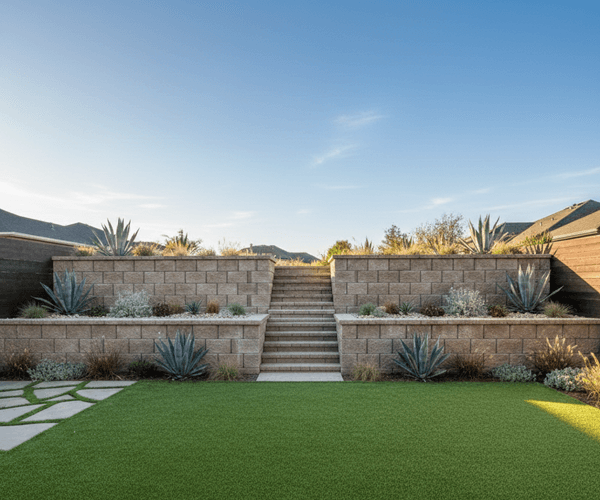
Steep or unusable slopes cost you yard space. Terraced retaining systems turn those slopes into flat, functional areas you can actually use. This service is common for hillside home sites, backyard drops behind fences, and graded lots where the original builder’s retention has failed.
Terraced wall systems break a tall slope into shorter, stepped sections. Each tier reduces soil pressure and creates planting shelves or usable patio areas between levels. Proper toe embedment and compacted backfill at each tier prevent shifting over time. The finished result gives you more usable ground and a cleaner look from every angle.
Terracing demand is strong in newer developments along the Highway 50 corridor near Folsom and El Dorado Hills. Graded hillside lots in those areas often leave homeowners with steep slopes that serve no purpose. Older Carmichael and Orangevale properties near creek ravines also benefit from stepped retention to prevent ongoing soil loss.
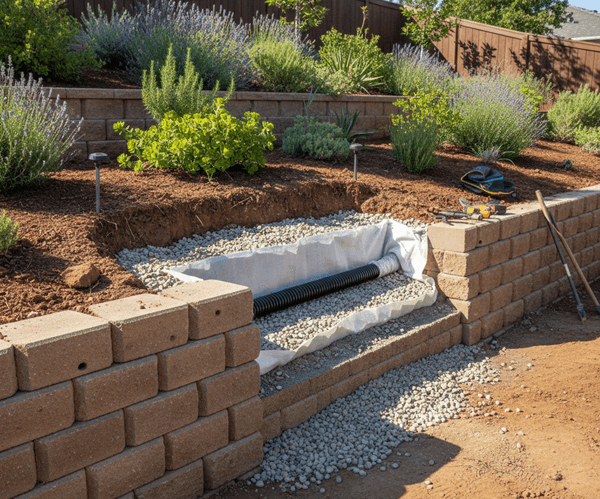
Every retaining wall traps water behind it. Without proper drainage, that water builds hydrostatic pressure and causes most wall failures. Drainage design is part of every wall we build. It also stands alone as a service for properties that need erosion control without a full wall.
If you are dealing with standing water, soil washout, or runoff threatening your foundation, drainage work can solve it. Services include perforated drain pipe installation, gravel backfill drainage layers, surface swales, and channel drains. For hillside erosion, we address washout, exposed root systems, and sediment runoff moving toward neighboring properties.
Sacramento County’s clay soils drain poorly on their own. Winter storms push water downhill through Orangevale, Fair Oaks, and Citrus Heights neighborhoods where gentle slopes become erosion problems over time. Properties near Arcade Creek, Cripple Creek, and San Juan Creek drainages see accelerated soil loss without intervention.
Getting drainage right the first time protects your wall, your yard, and your home’s foundation.
Some walls need more than gravity to hold. If your property requires a wall over four feet tall, a wall supporting a driveway or structure, or a wall on an unstable slope, engineered design is the answer. This service serves homeowners, developers, and general contractors dealing with significant grade changes that exceed standard wall limits.
Engineered walls use geogrid reinforcement, steel rebar, concrete footings, and calculated design to handle surcharge loads and tall grade changes. A licensed engineer provides stamped plans required by Sacramento County Building Permits. Expect soil testing, structural calculations, and inspections during construction. Nothing is guessed. Every detail is planned and documented before the first shovel hits the ground.
Sacramento County requires engineered plans for retaining walls exceeding four feet in exposed height. Properties along the bluffs near the American River Parkway, hillside lots in Gold River, and commercial developments in Rancho Cordova frequently need engineered wall solutions to meet code.
A leaning, cracking, or bulging wall is telling you something. Ignoring it leads to bigger problems and higher costs. If your wall shows signs of failure from poor original drainage, tree root intrusion, or soil settlement, repair work can stop the damage before it spreads.
Repair starts with diagnosing the cause of failure, not just patching what you can see. Common fixes include installing or replacing drain systems behind the wall, rebuilding failed sections, adding tiebacks or anchors to stabilize leaning walls, and replacing crushed or deteriorated block. Some walls need partial rebuilds rather than full replacement. We figure out which approach gives you the longest life at the right cost.
When a wall has failed beyond reasonable repair, full replacement is the next step. That includes walls with compromised footings, severe lean exceeding safe correction limits, or rotted railroad tie and timber walls. We remove the failed wall, regrade the slope, and build a new system designed to correct the original problems. Replacement often includes upgraded drainage, modern materials, and proper engineering when height requires it. Debris hauling and site restoration are part of the process.
Neighborhoods built in the 1960s through 1980s across Carmichael, Citrus Heights, and Rancho Cordova have aging retaining walls reaching the end of their service life. Oak tree roots along the Orangevale mesa frequently destabilize older block walls built without root barriers. Pressure-treated timber and railroad tie walls installed across Sacramento County subdivisions in the 1970s and 1980s are reaching total failure. Areas near Hazel Avenue in Orangevale, older sections of Folsom, and parts of Fair Oaks see frequent replacement needs as these wood walls rot, lean, and collapse under decades of soil pressure.
Yes, you may need a permit for a retaining wall in Sacramento County depending on the wall’s height. Walls over four feet in exposed height typically require a building permit and stamped engineered plans. Shorter walls may still need review if they support a slope, driveway, or structure. We check local requirements for every project and handle the permit process so you don’t have to guess.
You can tell your retaining wall needs repair or replacement by looking for visible warning signs. Leaning, cracking, bulging, or separation between blocks all point to structural problems. If water pools behind or at the base of the wall, drainage has likely failed. Minor cracking and small shifts may only need repair. Severe lean, crumbled footings, or rotted timber walls usually call for full replacement.
The best retaining wall for clay soil is one built with proper drainage behind it. In Sacramento’s clay-heavy ground, water retention creates pressure that pushes walls forward over time. Segmental block and poured concrete walls paired with perforated drain pipe and gravel backfill handle this well. The wall material matters, but the drainage design behind it matters more in clay conditions.


We install custom retaining walls in Orangevale, Folsom, Roseville, El Dorado Hills, Fair Oaks, and throughout the Greater Sacramento Area.